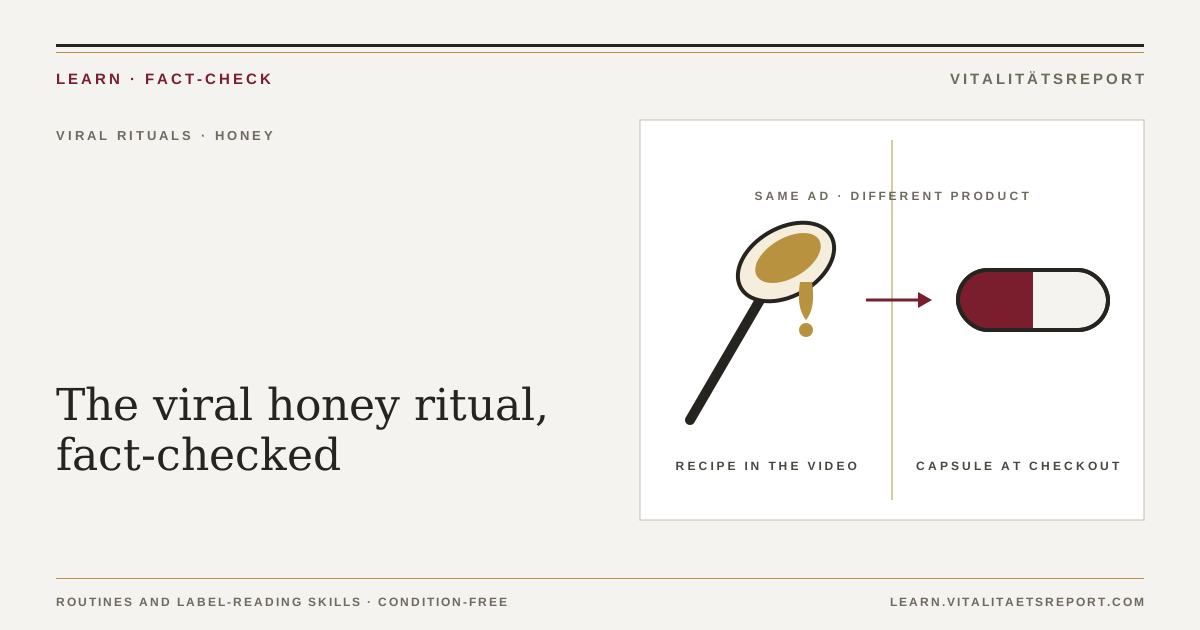
A video says a spoon of honey, stirred with a spice and taken at the right hour, will hand an adult past forty their memory, energy or sharpness back within days. The short answer: honey is a sugar with trace extras, the human trials on it are few and narrow, and the video is a sales funnel whose last page sells capsules rather than honey. The longer answer matters because the ritual is built from a handful of true facts stretched past what they can carry, and it helps to see exactly where each stretch happens.
The ad, in the order it unfolds
The videos share a script. They open like a news segment. A famous face appears, usually a technology founder, a news anchor or a television physician, and says things that person never said; the Better Business Bureau and local newsrooms have documented the AI-generated clips, and the office of at least one person depicted has stated that the backing is fabricated. The Federal Trade Commission's alert on the pattern describes "doctored video and audio that seems like the real thing." The narrator then promises a recipe, honey plus one or two kitchen ingredients, most often cinnamon, and dangles it for half an hour without ever fully delivering it. What arrives instead is a bottle: by the last screen the ritual is a capsule, sold in two-, three- and six-bottle tiers beside a countdown timer and a refund promise.
We opened one honey-named storefront of this kind on October 7, 2026, to see what the capsule holds. Its ingredient paragraph listed L-arginine in two forms, L-citrulline in two forms, beta-alanine, niacin and calcium. No honey. No cinnamon. The thing in the video and the thing in the cart are different products, and that is the first fact to hold onto.
Whatever honey can or cannot do, none of it transfers to a capsule that contains no honey. The recipe is the hook; the bottle is the sale.
What a spoon of honey actually contains
The USDA's reference entry for honey (FoodData Central, SR Legacy item 169640) settles the composition. Per 100 grams: 82.4 grams of carbohydrate, almost all of it sugar, split into 40.9 grams of fructose and 35.8 grams of glucose, with a few grams of galactose, maltose and sucrose making up the rest; 17.1 grams of water; 0.3 grams of protein; zero fat; 0.2 grams of fiber. Minerals are present but small: 52 milligrams of potassium, 6 of calcium, 2 of magnesium; vitamin C is half a milligram.
Scale that to the tablespoon in the ritual. At 21 grams, that tablespoon delivers roughly 64 calories and just over 17 grams of sugar, plus roughly 11 milligrams of potassium against a Daily Value of 4,700 and a tenth of a milligram of vitamin C against a Daily Value of 90. The polyphenols and enzymes that honey marketing leans on are real, but the 2008 review in the Journal of the American College of Nutrition that catalogs them describes honey's positive nutritional effects at intakes of 50 to 80 grams at a time, roughly two and a half to four tablespoons. At a teaspoon a day, honey is a pleasant sweetener with a faint mineral signature. That is the honest description.
What the human research has measured
Honey has a genuine research record; it is not about rituals, and its clearest findings concern coughs in children.
Coughs. The 2018 Cochrane analysis, drawing on six randomized trials and 899 children from toddlers to teenagers, concluded that honey probably relieves cough symptoms more than no treatment, placebo or an antihistamine, on low- to moderate-certainty evidence; the authors also noted that most children were treated for a single night and that there was no strong evidence for or against honey. The caveat came in 2022: a Japanese multicenter trial gave 161 children aged one to five either acacia honey or a honey-flavored placebo syrup before bed on two nights, and both groups improved with no difference between them. So: a modest, plausible effect on a cough, with the most recent well-controlled trial finding none. Nothing here concerns adults past forty, memory or energy.
Memory. The study these ads lean on, when they cite anything, is a 2011 trial in the journal Menopause. One hundred and two postmenopausal women in Malaysia were assigned for 16 weeks to 20 grams a day of one specific local honey (Tualang), to a prescription therapy group, or to no treatment. The honey group improved on immediate recall in a word-list test. They did not improve on recall after a distraction or on delayed recall. A review in Frontiers in Aging Neuroscience gathered 34 original studies on honey and the brain; most of them are rat and mouse studies, with only a few in people. The Alzheimer's Association's myths page states that it does not back any food, ingredient or supplement for memory-loss conditions, and names honey as its example.
Blood sugar and blood fats. A 2025 umbrella review pooled 69 randomized trials with 3,544 participants. Its finding is mixed: about 10 grams of honey a day may lower one long-term blood-sugar marker, while fasting glucose, triglycerides, systolic blood pressure and a marker of inflammation moved the wrong way; the authors advise caution with long-term or high-dose honey in people with existing health concerns. Honey's glycemic index runs from 32 to 85 depending on the floral source, and a 2018 Greek crossover trial in 11 healthy adults measured six honeys at 59 to above 70, medium to high. Honey raises blood sugar the way sugar does, because it mostly is sugar.
Sleep. Some versions move the spoon to bedtime. The only adult trial we found gave a milk-and-honey mixture twice a day for three days to 68 hospitalized cardiac patients in Iran, scored by questionnaire; it says nothing about a spoon of honey at home for a healthy adult. A 2024 paper in Food & Function proposing honey as a sleep aid is a narrative review with no trial of its own.
If you track your blood sugar or take medicine that affects it, count honey as sugar and ask your clinician before adding a daily spoon; the 2025 pooled analysis found fasting glucose, triglycerides and blood pressure moved the wrong way at about 10 grams a day.
Why the promise does not follow from any of it
The gaps are specific.
- The dose. The memory trial used 20 grams a day of one Malaysian honey for 16 weeks. The ad promises results in days, from any honey, from a teaspoon.
- The measure. The trial scored one word-list test and found a change on one part of it. The ad promises restored memory, energy and sharpness, which no honey trial has measured.
- The add-ins. Cinnamon and the other spices are presented as the "activator." We found no human trial of honey plus cinnamon for memory or energy.
- The product. The recipe is a spoon of honey. The checkout sells a capsule whose listed ingredients, on the storefront we opened, include no honey at all.
- The timeline. "Days" appears nowhere in the literature. Sixteen weeks is the shortest honey-and-memory study we found with a positive result, and the result was partial.
Each fact in the ad is true on its own. The chain between them is invented.
Red flags on the checkout page
On the honey-named storefront we opened on October 7, 2026, a two-minute check found:
- A badge asserting approval by the FDA sat beside text saying only that the product is made in an "FDA-registered facility." Registration is a filing; dietary supplements reach shelves without any FDA review of safety or effectiveness, a point the FTC's alert makes in plain words.
- A review counter showed 44,628 reviews at 5.0 out of 5, typed into the page, with no link to any review platform.
- Three pricing tiers under a "limited time, act now" banner: two bottles at $79 each ($158 plus $9.99 shipping), three at $69 ($207) and six at $49 ($294), each beside a struck-through figure that works out to $179 a bottle and that the page gives no history for.
- A 60-day refund promise on every tier, conditions on a separate page.
- No company name anywhere on the page.
- A footer linking to more than fifty other storefronts for other products, most of them spelling variations of a handful of brand names across different domain endings.
The FTC's advice for any ad with a famous face is short: search the name with the product and the word "scam," refuse to be rushed by a timer, and ask a health professional before buying a supplement.
What a honey label legally tells you
Under the FDA's 2018 honey-labeling guidance, honey is a single-ingredient food: its name is "honey," a floral source such as "clover honey" may be added if truthful, and no ingredient statement is required. If anything else is in the jar, such as corn syrup or sugar, the product cannot be called honey; it must be named as a blend, with the ingredients listed in descending order by amount. Net-weight and Nutrition Facts rules still apply, with exemptions for some small producers. Because honey counts as an added sugar under FDA labeling rules, a single-ingredient honey shows the percent Daily Value for added sugars, often with the gram amount in a footnote. The Daily Value is 50 grams a day on a 2,000-calorie diet.
"Raw" has no federal definition; the National Honey Board says it generally means the honey was not heated or filtered, and that the pollen this preserves is too small in amount to change the nutrient value. So look for the word "honey" alone in the name, a Nutrition Facts panel, a net quantity, and the name and address of the company. Any words about memory, energy, focus or days should slow you down.
A sensible place for honey in a daily routine
If you like honey, the evidence gives you a plain way to use it.
- Count it as sugar. One tablespoon is 17 grams, a third of the 50-gram added-sugar Daily Value. A teaspoon in tea or on oatmeal fits most days; a tablespoon on top of other sweets does not. Expect a medium-to-high blood-sugar response, and if you track your blood sugar, treat honey exactly as you would table sugar.
- Pick the moment for taste, not timing. No trial supports a morning or bedtime slot for a healthy adult.
- Keep honey away from babies younger than 12 months, whether on its own, in foods made with it, or on a pacifier. The CDC's warning concerns the botulism bacteria that honey can carry.
- Keep the spoon and skip the capsule. If a honey video has a bottle at the end, close the tab.
If you want a jar: a plain, labeled option
We looked for an established brand with a plain label. Nate's 100% Pure, Raw & Unfiltered Honey, long sold under the Nature Nate's name, fits; we checked the 32-ounce squeeze bottle. When we checked the Amazon listing on October 7, 2026, it was $14.47, shipped and sold by Amazon.com, in stock, with "Honey" as the only listed ingredient and Nature Nate's named as the manufacturer. The listing is marked non-returnable for food-safety reasons, so order the size you will use. We recommend it as a sweetener with a clean label, which is all honey has earned.
Plain link: amazon.com/dp/B00CMQD3VS. As an Amazon Associate we earn from qualifying purchases. Amazon sets the price, seller and availability, and any of them can change.
Sources
- USDA FoodData Central. Honey, SR Legacy item 169640: energy, water, sugars by type, protein, fiber, minerals and vitamins per 100 g; tablespoon weight 21 g. link
- Journal of the American College of Nutrition, 2008;27(6):677–689. Review of honey composition, its glycemic index range of 32 to 85 and the intakes at which nutritional effects are described. PubMed 19155427. link
- Cochrane Database of Systematic Reviews, 2018. Honey for acute cough in children: six randomized trials, 899 children aged 12 months to 18 years. PubMed 29633783. link
- Acta Paediatrica, 2022. Multicenter randomized placebo-controlled trial of acacia honey for nocturnal cough and sleep in 161 children aged 1 to 5. PubMed 35927828. link
- Menopause, 2011. Randomized 16-week trial of 20 g/day Tualang honey in 102 postmenopausal women: immediate recall improved, delayed recall did not. PubMed 21926932. link
- Frontiers in Aging Neuroscience, vol. 14 (published online 2023). Review of 34 original studies on honey and brain health, mostly in animals. PubMed 36733498. link
- Nutrition & Diabetes, 2025. Umbrella review and updated meta-analysis of honey and bee products on cardiometabolic outcomes: 69 randomized trials, 3,544 participants. PubMed 41261111. link
- European Journal of Clinical Nutrition, 2018. Randomized crossover trial of the glycemic response to six Greek honeys in 11 healthy adults. PubMed 29686412. link
- Clinical Nutrition ESPEN, 2018. Milk-and-honey mixture and questionnaire-scored sleep in 68 hospitalized cardiac patients over three days. PubMed 30390870. link
- Food & Function, 2024. Narrative review proposing honey as a sleep aid; no trial of its own. PubMed 39248637. link
- Alzheimer's Association. Myths page, item on prevention by a specific food or supplement; the Association does not back any food, ingredient or supplement, honey named as the example. link
- Federal Trade Commission, Consumer Advice. "Did a celebrity really endorse THAT? Maybe not." April 24, 2024: doctored video and audio, pressure to act fast, supplements are not reviewed before sale. link
- NBC Chicago, June 30, 2026. Better Business Bureau warning on AI-generated celebrity clips selling honey-based memory supplements; unauthorized recurring charges reported. link
- US Food and Drug Administration. Guidance for Industry: Proper Labeling of Honey and Honey Products, February 2018: honey as a single-ingredient food, floral-source names, blends with other sweeteners. link
- US Food and Drug Administration. Added Sugars on the Nutrition Facts Label: honey counted as an added sugar, 50 g Daily Value, footnote rule for single-ingredient sugars. Current as of March 4, 2026. link
- US Food and Drug Administration. Daily Value on the Nutrition and Supplement Facts Labels: potassium 4,700 mg, vitamin C 90 mg, added sugars 50 g. link
- Centers for Disease Control and Prevention. Botulism prevention: do not feed honey, or products made with it, to children under 1 year. link
- National Honey Board. FAQ: no federal definition of "raw" honey; pollen content and nutrient value; crystallization and storage; infants and honey. link
- Storefront for a honey-named capsule, opened October 7, 2026 (not linked): ingredient paragraph, approval badge, review counter, pricing tiers and footer links as described above. Amazon listing for Nate's (formerly Nature Nate's) 32 oz raw honey, ASIN B00CMQD3VS, checked the same day.
This article is educational and is not medical advice. Ask a qualified clinician before changing a routine or starting any supplement.